

United Gaming Advisors / Monte Cristo Gaming — November 3, 2026
Polls close at 8 p.m. tonight in Pennsylvania. No ballot question covers skill games, but the results will decide who writes the next set of rules. Here is where we stand: who we want to win, which races matter most, and how each is shaping up before results. The facts below are reported and sourced. The picks and rankings are my opinion, made on one test: who is most likely to deliver a legal, regulated market with economics that work for operators and locations.
What is already settled
In June, Pennsylvania's Supreme Court held that about 70,000 skill games are slot machines. Lawmakers let the Oct. 13 enforcement date pass without a bill, and Pace-O-Matic disabled its machines, saying it is complying. Now the focus turns to the elections and how they will shape skill game legislation.
The short answer: we back people and a bill, not a party
Neither party is cleanly on our side. Both caucuses have allies and both have obstacles.
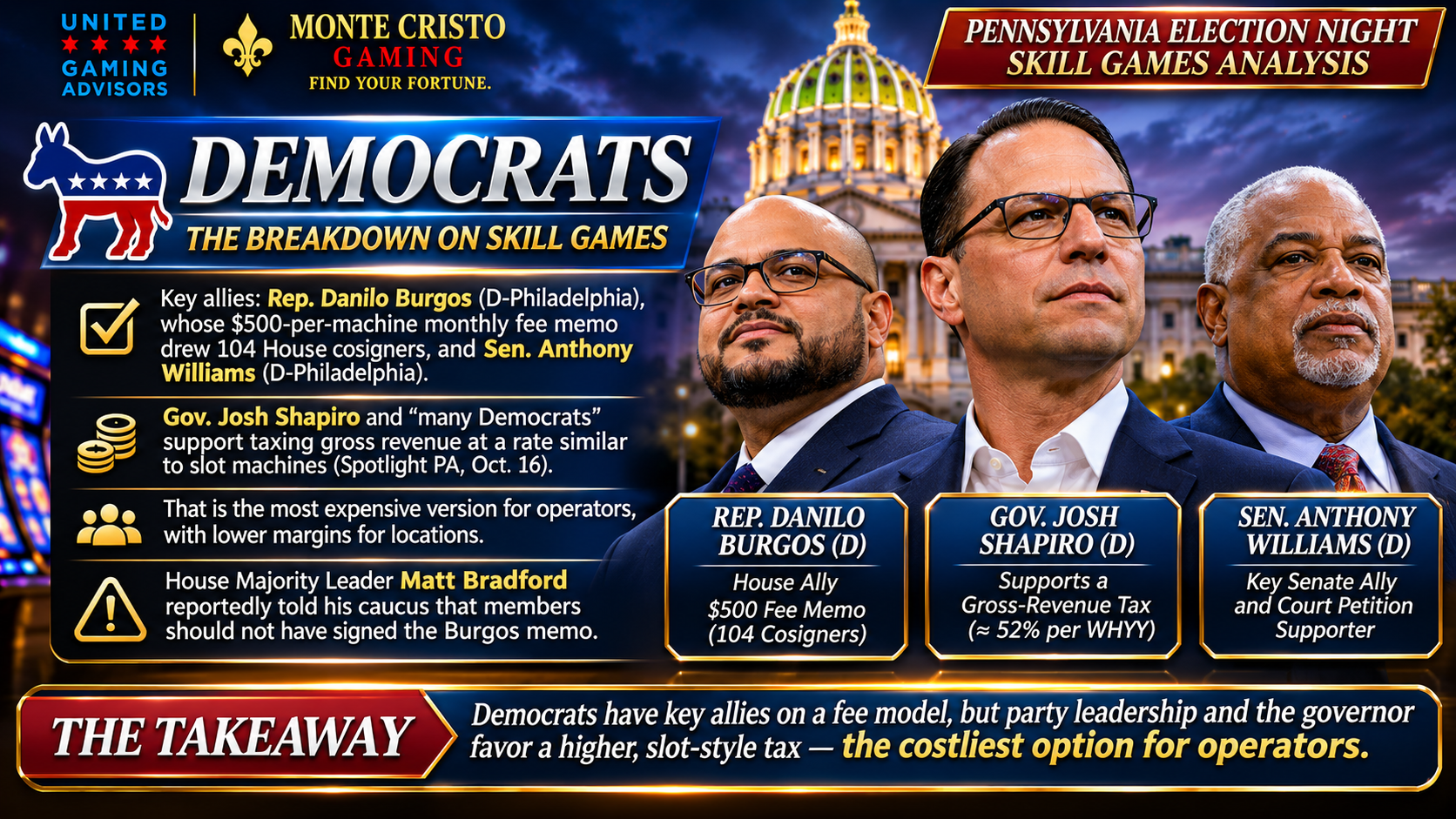
Democrats include our strongest House ally, Rep. Danilo Burgos (D-Philadelphia), whose $500-per-machine monthly fee memo drew 104 House cosigners, and Sen. Anthony Williams (D-Philadelphia). But Gov. Shapiro and "many Democrats" support taxing gross revenue at a rate similar to slot machines (Spotlight PA, Oct. 16). That is the most expensive version for operators. House Majority Leader Matt Bradford reportedly told his caucus that members should not have signed the Burgos memo.
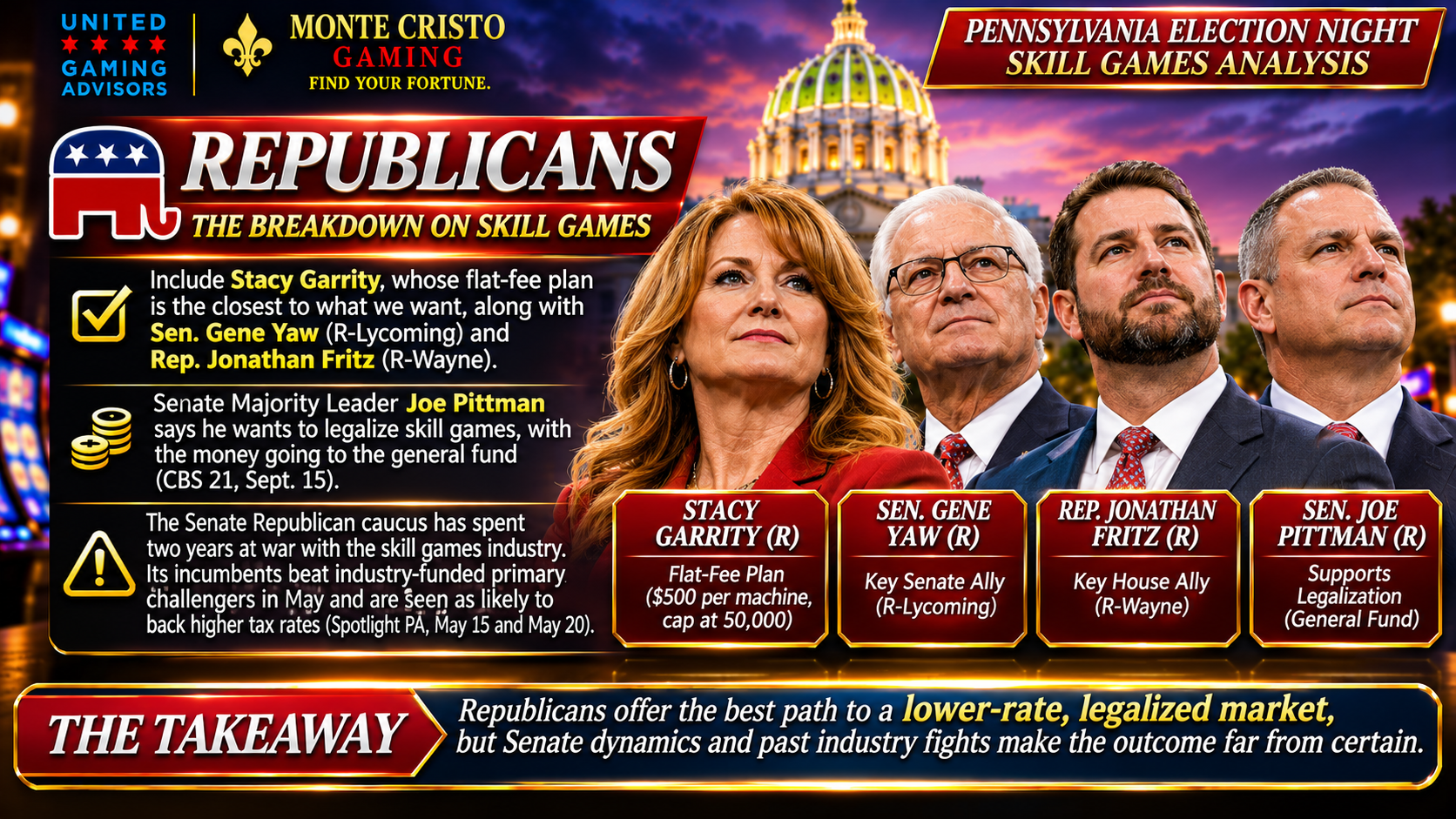
Republicans include Stacy Garrity, whose flat-fee plan is the closest to what we want, Sen. Gene Yaw (R-Lycoming) and Rep. Jonathan Fritz (R-Wayne). Senate Majority Leader Joe Pittman says he wants to legalize skill games, with the money going to the general fund (CBS 21, Sept. 15). But the Senate Republican caucus has spent two years at war with the skill games industry. Its incumbents beat industry-funded primary challengers in May and are seen as likely to back higher tax rates (Spotlight PA, May 15 and May 20).
So our pick is the bill: a flat per-machine fee in the range of the Burgos $500 memo, and the candidates most likely to pass it.
Who we want to win, and how they're performing
Performance is a pre-results snapshot. WHYY's live results page had nothing posted when I checked.
Governor
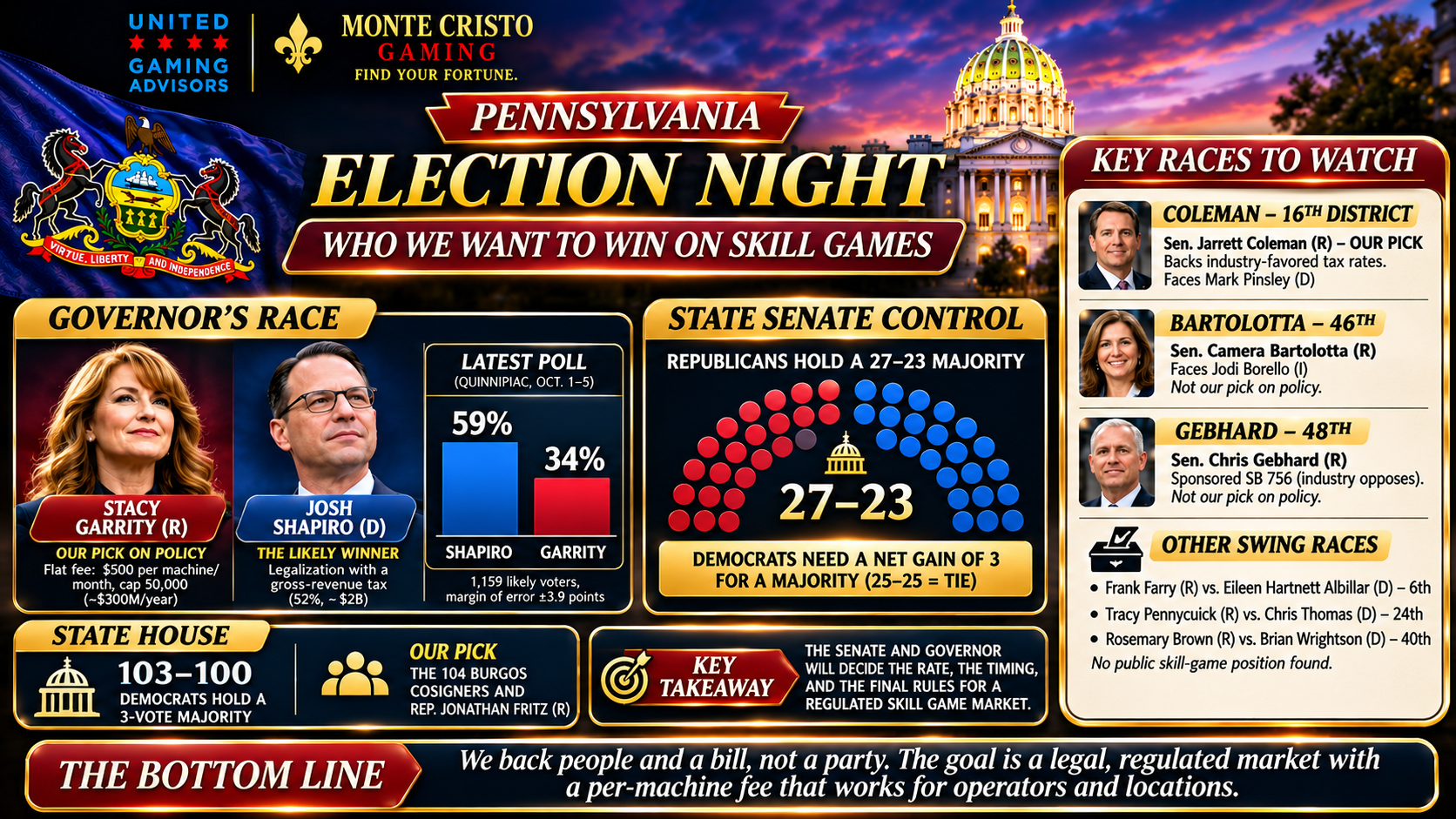
Our pick on policy: Stacy Garrity (R). She backs a flat fee aligned with industry demands: $500 per machine per month, capped at 50,000 machines, about $300 million a year by WHYY's estimate (WHYY, Oct. 30). She says she would call the Legislature back for immediate action.
How she's performing: behind. Quinnipiac (Oct. 1-5, 1,159 likely voters, margin of error 3.9 points) had Shapiro ahead 59% to 34%. That poll is a month old, but it is the most recent independent likely-voter poll I could verify.
Caveat: skill-games interests gave at least $4.5 million of the almost $5.4 million she raised from Sept. 15 to Oct. 19 (Spotlight PA, Oct. 30). If she wins, expect a fight over whether the plan was written for the industry.
The likely winner: Josh Shapiro (D). He backs legalization, which matters, but at a gross-revenue tax similar to slots. WHYY puts his plan at 52%, about $2 billion. If he wins, our job is not to oppose him. It is to push the rate down.
State Senate (the race that matters most)
Republicans hold the Senate 27-23. Democrats need a net gain of 3 for a majority. A gain of 2 makes a 25-25 tie, and Lt. Gov. Austin Davis breaks ties only on procedural matters (WHYY, Oct. 19). Sen. Williams says the future of skill games depends on who controls it.
What each outcome means for us:
Republicans keep the Senate: the best leverage for a lower rate, since Pittman wants legalization and opposes using the money for transit, but also the status quo that produced no bill in three years. House Democrats say Senate Republicans have not passed their own members' bills. Favorability: moderate. Better economics, slower.
Democrats take the Senate (with Shapiro): the fastest path to a bill, because one party controls everything. But it is most likely on Shapiro's terms, a slot-style tax. Favorability: moderate. Faster, worse economics.
25-25 tie: more gridlock. Favorability: low.
Named Senate candidates:
Sen. Jarrett Coleman (R, 16th, Lehigh/Bucks): our pick. He has publicly backed industry-favored tax rates and is not for a ban. Operators for Skill has given him $426,000 (Spotlight PA, May 15). He faces Lehigh County Controller Mark Pinsley (D) in one of the four races Democrats need. I found no public skill-games position from Pinsley.
Sen. Gene Yaw (R) and Sen. Anthony Williams (D): our two clearest Senate allies. Both joined the October court petition to extend the deadline. Neither is in a listed swing race.
Sen. Camera Bartolotta (R, 46th) faces independent Jodi Borello today. She beat an industry-funded challenger in May and is seen as likely to back higher tax rates. Not our pick on policy, though she is favored to win.
Sen. Chris Gebhard (R, 48th) sponsored SB 756, which the industry opposes. Not our pick on policy.
Unknown: Frank Farry (R) vs. Eileen Hartnett Albillar (D) in the 6th; Tracy Pennycuick (R) vs. Chris Thomas (D) in the 24th; Rosemary Brown (R) vs. Brian Wrightson (D) in the 40th. These swing races could decide control, and I found no public skill-games position from any of these six candidates. That is the gap I will close after tonight, when the winners take a position.
State House
Democrats hold it 103-100, and Republicans need a net gain of 2 (WHYY, Oct. 19). Speaker Joanna McClinton has said the House is open to regulating and taxing the games. The 104 Burgos cosigners show a fee bill can already pass the House. Our pick: the 104 cosigners and Rep. Fritz (R). I don't have the full list of cosigners or their party split, so I am not naming more individuals.
Ranked by importance
State Senate control. It is the gatekeeper, and every plan has to clear it.
Governor. It decides the tax model, flat fee versus slot-style.
Coleman's 16th District seat. It is our clearest Senate ally in a swing race.
House margin. A fee bill already has the votes.
Campaign money. It signals how hard the industry will lobby in 2027.
The calendar. Nov. 4 is the DeLeo Games removal date. The session adjourns Nov. 30, and Spotlight calls action before year-end "likely out of the question."
Prospective Investor Inside Analysis
My view, not fact or a forecast. The likeliest result is Shapiro as governor. The Senate decides whether 2027 is a fast bill at a high rate or a slow negotiation at a better rate. In either case the winning operators will be the ones that document their compliance and their ancillary sales now. That is the evidence that moves a rate. For regulated operators, the opening is to be the better partner to locations that lost a revenue line, and to win organic business the right way.
Chicago VGT Live Tracker
IGB lists pulled Nov. 3 (City = Chicago): 78 licensed, unchanged (latest status date 10/22). Pending is 287, up two from Nov. 2. That is new applications, not decisions. No new City Council action confirmed.
Investors and operators: If you want in on this market, reach out and I'll show you how to win organic business the right way. Bar, club or store owners: message me about your compliant options. contact@montecristogaming.com
PA skill games operators: your before-and-after ancillary sales are the evidence lawmakers will want in 2027. Message us today to join the impact study.
Sources
Spotlight PA, Oct. 16 · Spotlight PA, May 15 · Spotlight PA, May 20 · Spotlight PA, Nov. 2 · CBS 21, Sept. 15 · WHYY, Oct. 19 · WHYY, Oct. 30 · Quinnipiac, Oct. 7
