

United Gaming Advisors / Monte Cristo Gaming — November 17, 2026
For years, the companies behind Missouri's unregulated gaming machines called them a "gray area." On Monday, the state and two federal prosecutors put a price on that idea.
Torch Electronics, the St. Louis company behind thousands of unregulated slot-style machines in gas stations and convenience stores, agreed to pay Missouri $13.5 million in restitution and shut down its machines in stores, gas stations and bars. The money goes to the Gaming Proceeds for Education Fund, paid over two years. If Torch breaks the deal, it owes another $6.5 million (Jefferson City News-Tribune, Nov. 17; Hannibal Courier-Post, Nov. 16; Missouri Independent, Nov. 16).
What the agreement does
Who's involved: Attorney General Catherine Hanaway announced the deal alongside the U.S. Attorneys for the Eastern and Western Districts of Missouri, after a joint criminal investigation. The Missouri Independent calls it a non-prosecution agreement.
What Torch gives up: its machines in convenience stores, gas stations, bars and other retail locations, until it wins in court or lawmakers legalize the games. The agreement also binds any successor company.
What Torch gets: the agreement resolves all ongoing civil and criminal investigations into the company, and it is not an admission of liability (News-Tribune).
The exception: Torch can keep operating machines in bona fide veterans halls, fraternal clubs and other qualifying nonprofits, and it can sign up new nonprofit locations until Jan. 1, 2027 (Missouri Independent; KY3, Nov. 16). Hanaway called it prosecutorial discretion and said Torch insisted on it.
Torch had already pulled its retail machines in April under an earlier agreement with Hanaway. Monday's deal is the bill.
The line I keep rereading comes from U.S. Attorney R. Matthew Price: "From our perspective, there was never anything gray about these machines under federal law" (KBIA).
Three states, one message
Look at this year:
Pennsylvania: the 120-day stay after the state Supreme Court's skill-game ruling ran out Oct. 14 with no law passed, and the State Police started removals (iGaming Business, Oct. 15).
Wyoming: kept skill games legal but limited them to bars, truck stops and smoke shops, behind a 21+ line, and is lining up a 2027 felony for online sweepstakes.
Missouri: the biggest unregulated operator is paying restitution and pulling its machines out of stores and bars.
Different tools, same message. Unregulated machines don't get grandfathered in. They get shut down, and sometimes they get billed.
What it means for Missouri in 2027
Missouri still has no legal framework for these machines. HB 2989, which would have licensed and taxed video lottery terminals, passed the House in February and died in the Senate in May (KBIA). Lawmakers can start prefiling for 2027 in December.
To me, this deal cleans up a big, dirty mess. It gets the biggest operator's machines out of stores and bars, and Hanaway says she's negotiating with the other vendors. And it takes away the argument that kept stalling the Senate: do we legislate and regulate something that's already in place? Keeping games in the veterans and fraternal halls leaves that door open a crack. But the deal clears enough of the retail market that Missouri can basically write whatever law it wants in 2027.
My crystal ball for 2027
My view, not fact or a forecast.
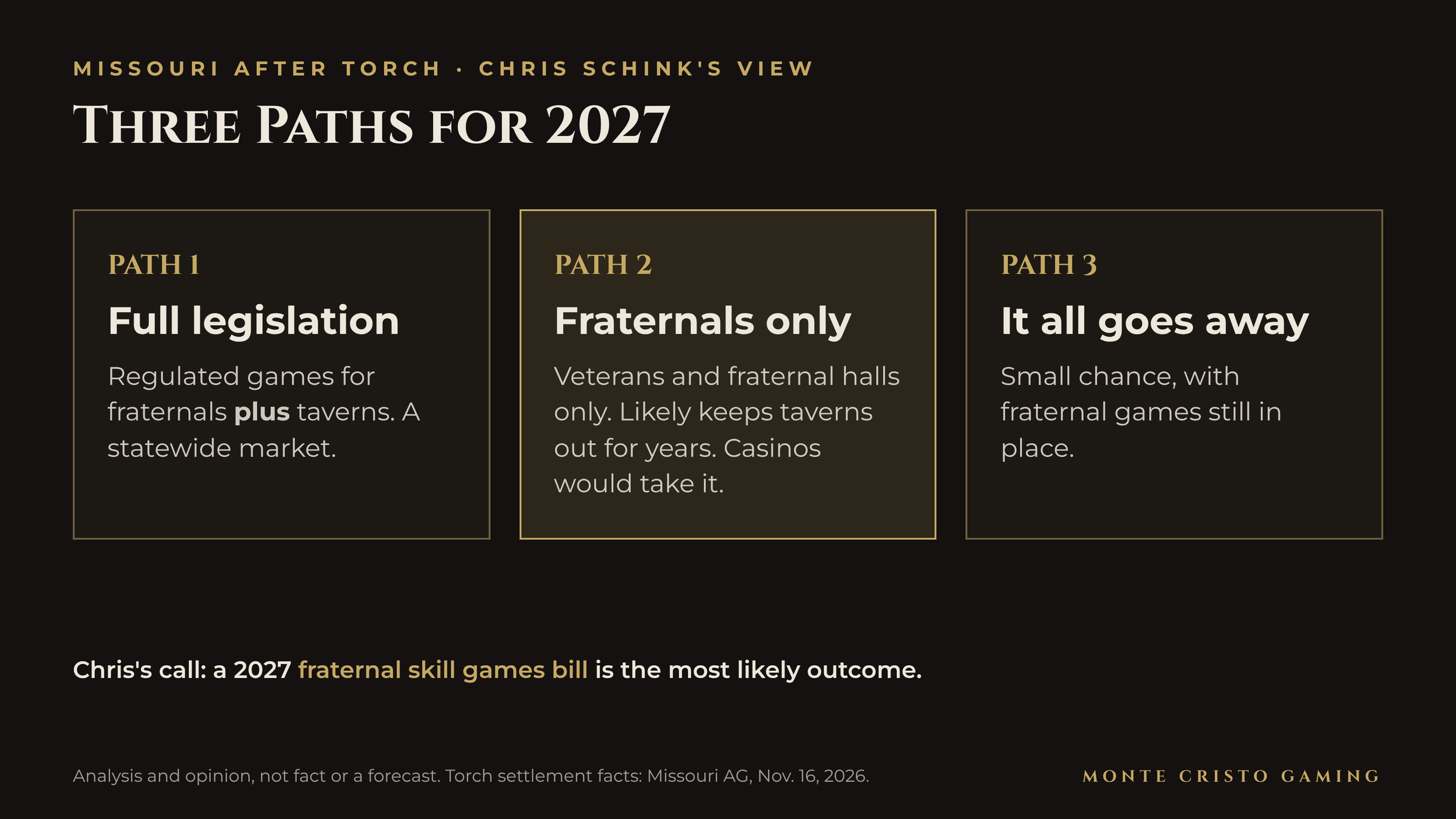
If I had to call it, I'd say a 2027 fraternal skill games bill is coming. Here's how I think each side lands:
Casinos would likely accept it. A fraternals-only bill is a huge win compared with the statewide bills they fought.
Distributed gaming operators wouldn't want that deal, but it gives them something.
Veterans and fraternal halls keep the games. That's the argument skill-game operators always pointed to, but they used it to keep machines everywhere, not just in the halls.
That opens three paths:
One more detail matters. Torch made no admission of liability. That tees it up to still be eligible to apply for a license in 2027 or 2028, under whatever regulation Missouri passes. The agreement even looks ahead: if lawmakers authorize Missouri Lottery video lottery games, Torch machines could operate during the transition (Missouri Independent). One caveat: a federal jury found in October 2025 that Torch's machines violated Missouri gambling laws (Missouri Independent, Oct. 2025), and a regulator could weigh that.
The Pennsylvania parallel
This is the same story we just watched in Pennsylvania. For years, people talked about getting the 50,000 to 70,000 skill games across the state regulated, with Pace-O-Matic keeping a foothold until a law arrived. After the Supreme Court ruling, those games came out too (iGaming Business, Oct. 15). Now 2027 is clear and open for legislation and regulation in both states.
Prospective Investor Inside Analysis
My view, not fact or a forecast.
Pennsylvania: I think a better, more certain deal is coming from a legislation standpoint, with a wider net.
Missouri: something will be available in 2027, but probably narrower.
Here's what I love about it. If you're an operator who ran routes in Illinois, Louisiana, West Virginia or Nevada, treated your license as sacred, and put compliance and responsible gaming first (like I did when I ran my routes), this is really good news. The old playbook was simple: a gray operator held the locations, then collected the deals when legislation finally came. In Pennsylvania and Missouri, that head start is mostly gone. (Torch can still sign nonprofit locations through the end of the year, and the transition clause above is worth watching.) I don't think those operators can tell the same "we made this happen for you" story anymore. They sort of did, they sort of didn't, but they were told they were doing it the wrong way, and the retail games are gone.
I like it as a regulated guy. Gray market was never a business plan. It was a liability that hadn't been priced yet, and Missouri just priced one at $13.5 million. Good, clean gaming is coming.
Action items for Chicago owners
1. Don't confuse "available" with "legal." If a vendor offers to drop a "skill" or "sweepstakes" machine in your bar while Chicago licensing gets going, say no. In Missouri, federal prosecutors called those machines illegal under federal law. Your liquor license and your future gaming license are worth more.
2. Check both lists. As of this morning, the Illinois Gaming Board lists 78 Chicago locations licensed, 297 pending and 2 denied (IGB lists). The city's business-license data shows 17 Chicago locations and 6 terminal operators with a city video gaming license (City of Chicago data portal). Being on one list doesn't put you on the other.
3. Pick a partner who's on the regulated side. Ask any operator where they stand with the Gaming Board, in writing.
Bar, club or store owner in Chicago? Click Here to Become the House. No Obligation, Walk Anytime. Revenue figures are estimates from Gaming Board data, never promises. Monte Cristo Gaming is an applicant, not a licensed operator. Investors and operators: contact@montecristogaming.com. 21+. Problem gambling help: 1-800-GAMBLER.
Sources: Jefferson City News-Tribune, Nov. 17 · Hannibal Courier-Post, Nov. 16 · Missouri Independent, Nov. 16 · KY3, Nov. 16 · KBIA / Columbia Missourian, Nov. 17 · Missouri Independent, Oct. 2025 · iGaming Business, Oct. 15 · IGB lists · City of Chicago data portal
Video photo credits: Missouri State Capitol by KTrimble (CC0); Pennsylvania State Capitol by governortomwolf (CC BY 2.0); VFW post by Evvekk (CC0); gavel via rawpixel (CC0).
