

On Nov. 1, Oklahoma's ban on dual-currency sweepstakes casinos took effect. Under SB 1589, running or supporting one is a Class C2 felony, and the law reaches past the operator to suppliers, payment processors, geolocation providers and affiliates. The legislature passed it over Gov. Kevin Stitt's veto in May. Several large brands have reportedly left the state or blocked Oklahoma players (PressBee, republishing ReadWrite).
What is confirmed
Multiple outlets reported the veto override and the Nov. 1 start date (Bettors Insider, May 18; Gambling.com, Oct. 8). The bill's Senate floor summary specifies a Class C2 felony offense (Oklahoma Legislature); one Gambling.com summary said Class C, so check the classification before you rely on it. The detail about felony exposure for suppliers and affiliates comes from an Oct. 31 republication of a ReadWrite piece, which I have not read in the original, so I'm treating it as reported, not verified.
How prolific was it, and how big was the market?
Prolific, yes. Big in Oklahoma specifically, nobody can say with a straight face, and I won't pretend otherwise.
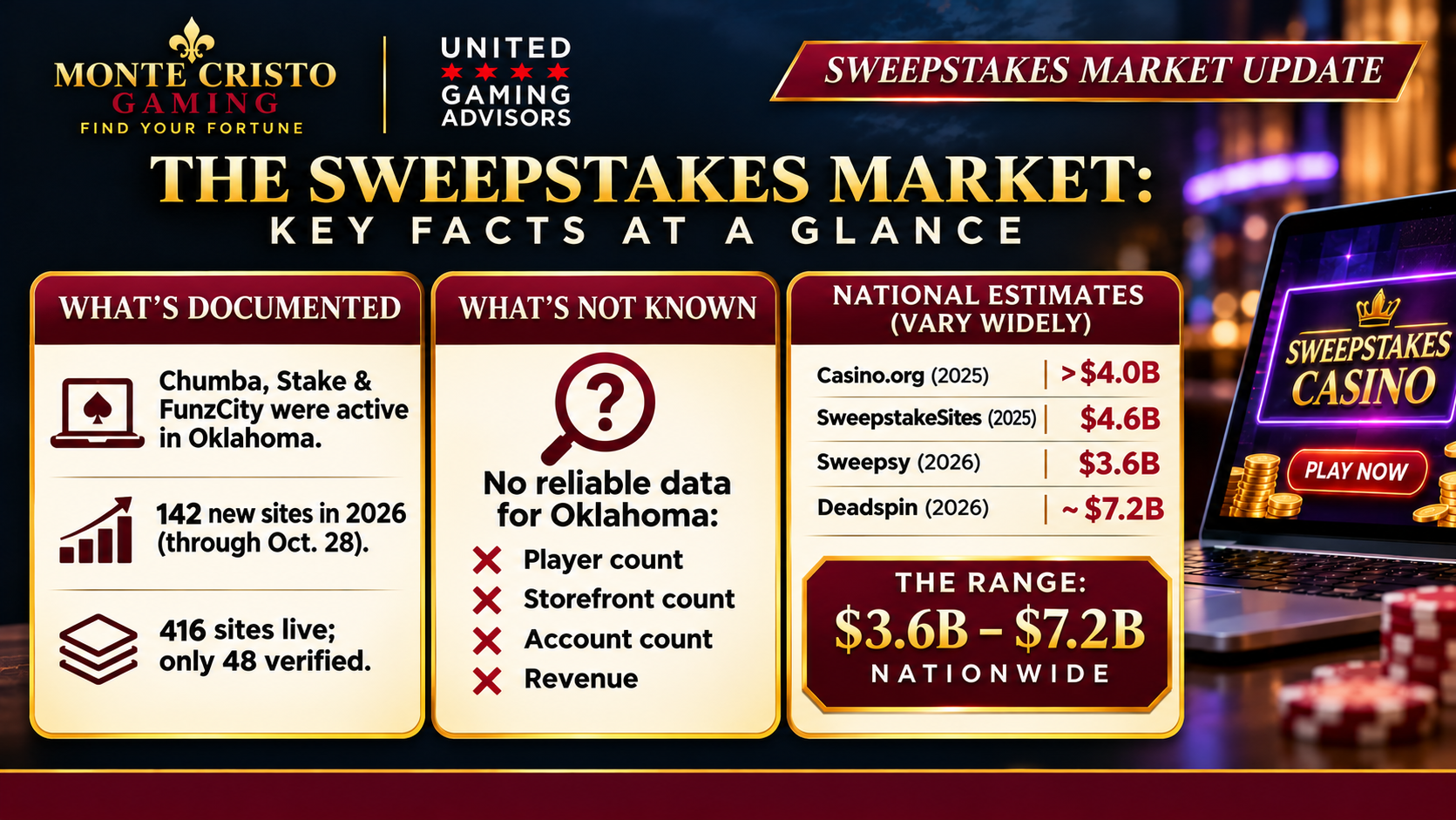
What is documented. When the veto was overridden in May, Casino.org reported that Chumba Casino, Stake and FunzCity were still active in Oklahoma. Nationally, Sweepsy (an affiliate site) counted 142 new sweepstakes casinos launched in 2026 through Oct. 28, 416 sites live, and more than two dozen closures. It says it has verified only 48 of the 416. That count is a media tracker, not a regulator's list. Some operators run several brands at once, which is how a few companies can look like a crowd.
What nobody has published. I found no player count, storefront count, account count or revenue figure for Oklahoma sweepstakes play from a regulator, academic or audited source. Anyone quoting an Oklahoma sweepstakes number is guessing.
The national estimates disagree. To be clear, every market-size figure below is a national number for the whole U.S. sweepstakes industry, not an Oklahoma number. Casino.org (May 15) said unattributed estimates put U.S. sweepstakes gross gaming revenue above $4 billion in 2025. SweepstakeSites, an affiliate publisher (April 2), estimated $4.6 billion nationally for 2025 and projected about $3.6 billion for 2026; Sweepsy (Oct. 29) repeats the same pair as "industry projections," so it is not independent confirmation. Deadspin (Aug. 31), citing Blask, reported nearly $7.2 billion nationally for 2026. No source states a method. Those numbers point opposite ways, so I'd treat the whole range, roughly $3.6 billion to $7.2 billion nationwide, as the honest answer: large, and not measured well. Oklahoma's share of that is unknown.
Scale against what Oklahoma already has. Oklahoma's tribes reported more than $3.6 billion in gross gaming revenue for the fiscal year ending June 30, 2025, and $221 million went to the state (Gambling.com, May 19; Casino.org). That is tribal casino data, not sweepstakes data. I use it only as a yardstick: the tribes pushed this ban because they were the licensed side watching an unlicensed product compete for the same player.
My view, not fact: if even a small slice of the national figure touched Oklahoma, it was enough to move a legislature to override a governor. That, more than any dollar estimate, tells you how seriously the licensed side took it.
Why a VGT person cares
I work in distributed gaming, not online sweepstakes. But the pattern is the same one I see in Pennsylvania. When a product looks like gambling and dodges the license, tax and age checks, states eventually stop treating it as a licensing question and start treating it as a crime. Pennsylvania got there on skill games through the courts: the Supreme Court ruled in June that roughly 70,000 machines are slot machines, and the stay ran out Oct. 13 without legislative action (Spotlight PA, Oct. 16). Governor Shapiro has advocated a steep tax on skill games to raise transit money, the Philadelphia Inquirer noted Nov. 4, though no bill vehicle has been named.
Prospective Investor Inside Analysis
My view, not fact or a forecast. Three takeaways.
First, the supply chain is now the target. Oklahoma's reach to payment and geolocation vendors means compliance risk travels up and down the chain. If you supply or finance anyone in a gray market, ask who is carrying the exposure.
Second, licensed networks gain when gray products are removed. Illinois video gaming has a regulator, a tax structure and a Chicago pipeline that keeps growing. That is the asset to document.
Third, legislation is slow, enforcement is not. Pennsylvania's legislature let the court deadline pass, and the machines went dark anyway. Operators should plan for the rule that is enforced, not the bill that might pass.
Chicago VGT Live Tracker
Illinois Gaming Board lists pulled Nov. 6 (City = Chicago): 78 licensed, unchanged (latest status date 10/22). Pending is 291, up one from Nov. 5, newest status date 11/05. Those are applications, not decisions. Denied remains 2. No new City Council action confirmed.
Other markets
Nothing dated Nov. 5-6 confirmed for Illinois statewide, Missouri, Georgia, Texas, Nevada, West Virginia, Montana, Oregon or Nebraska.
Investors and operators: If you want in on this market, reach out and I'll show you how to win organic business the right way. Bar, club or store owners: message me about your compliant options. contact@montecristogaming.com
Sources: Bettors Insider · Gambling.com, Oct. 8 · PressBee/ReadWrite · Gambling.com, May 19 · Casino.org · Deadspin/Blask · SweepstakeSites · Sweepsy · Spotlight PA · Philadelphia Inquirer · IGB lists
